
You turn the key, and instead of the engine catching, you hear a slow groan, a rapid clicking, or nothing at all. A dead battery is one of the most common reasons drivers get stuck, and in a Detroit winter it can happen on the coldest morning of the year, right when you need to be somewhere. The good news is that a jump start is a skill almost anyone can learn. This step by step guide explains how to jump start a car safely, what to check first, what mistakes to avoid, and when it makes more sense to call for dead battery help in Detroit.
Signs Your Battery Is the Problem
Before you reach for the jumper cables, make sure a weak battery is actually the cause. Common signs include:
- The engine cranks slowly or struggles to turn over
- You hear rapid clicking when you turn the key or press the start button
- The dashboard lights and interior lights are dim or flicker
- The headlights are weak, or nothing lights up at all
- The car started fine yesterday but will not today, especially after a cold night
- You left a light or accessory on while the car was off
If the engine cranks strongly but will not start, the battery may be fine and the problem could be fuel, spark, or a sensor. Our guide to the top 10 reasons your car won’t start and how to get back on the road explains how to tell the difference.
What You Need
- A set of jumper cables in good condition, with thick wire and clean clamps, or a portable jump starter
- A second vehicle with a healthy battery, if you are using cables
- Your owner’s manual, for any instructions specific to your car
- Gloves and eye protection, if you have them
- A flashlight, if it is dark
Short, thin, or damaged cables can fail to deliver enough power, so it is worth keeping a good set in the trunk during the winter months.
Safety Checks Before You Begin
Batteries contain acid and can release flammable gas, so a few quick checks matter before you connect anything.
- Read your owner’s manual. Some vehicles have designated jump start terminals under the hood instead of direct access to the battery, and some hybrid and electric vehicles have special instructions or may not be suited to jump starting from another car
- Look at the battery. If the case is cracked, bulging, leaking, or frozen, do not try to jump it. Call a professional
- Keep sparks, flames, and cigarettes away from the battery
- Remove loose jewelry and keep hair and clothing clear of the engine bay and moving parts
- Make sure both batteries have the same voltage. Most passenger cars use 12 volts, but check before connecting
- Work on level ground and set the parking brake
Step by Step: How to Jump Start a Car With Cables
Step One: Position the Vehicles
Park the working car close enough for the cables to reach, front to front or side by side, but do not let the vehicles touch. Put both in park, or neutral for a manual transmission, and set both parking brakes.
Step Two: Turn Everything Off
Turn off both engines, and switch off the lights, radio, heater, and other accessories in both cars. Remove the keys from the ignition on the dead car if your manual advises it.
Step Three: Open the Hoods and Find the Terminals
Locate the battery or the jump start terminals. The positive terminal is usually marked with a plus sign and often has a red cover. The negative terminal is marked with a minus sign. If the terminals are dirty or corroded, wipe them carefully so the clamps can make good contact.
Step Four: Connect the Cables in the Right Order
The order matters, because it helps keep sparks away from the battery. Follow this sequence:
- Attach one red clamp to the positive terminal of the dead battery
- Attach the other red clamp to the positive terminal of the good battery
- Attach one black clamp to the negative terminal of the good battery
- Attach the final black clamp to a clean, unpainted piece of metal on the dead car, such as an engine bracket or a designated ground point, away from the battery and away from moving parts
Make sure the clamps are firmly attached and the cables are clear of belts and fans. Never let the metal ends of the clamps touch each other while they are connected to a battery.
Step Five: Start the Working Car
Start the engine of the good car and let it run for a few minutes. Some drivers also hold the engine at a slightly raised idle, but the main point is to give the dead battery time to take on some charge.
Step Six: Try to Start the Dead Car
Now try to start the car with the dead battery. If it starts, leave both cars running while you remove the cables. If it does not, wait a few more minutes and try again. If it still will not start after a couple of attempts, stop. Repeated cranking can overheat the starter, and the problem may be more than a drained battery.
Step Seven: Remove the Cables in Reverse Order
Take the cables off in the opposite order you put them on:
- Remove the black clamp from the metal ground point on the formerly dead car
- Remove the black clamp from the good battery
- Remove the red clamp from the good battery
- Remove the red clamp from the formerly dead battery
Keep the clamps from touching each other or any metal as you remove them.
Step Eight: Keep the Engine Running
Do not shut the car off right away. Drive it for a while so the alternator can recharge the battery, and avoid using heavy accessories like the seat heaters and rear defroster at first. A longer drive is better than a short trip. If the car will not restart the next time, the battery is probably no longer holding a charge.
Using a Portable Jump Starter
A portable jump starter is a compact battery pack that lets you jump your car without another vehicle. The general process is similar. Make sure the unit is charged, connect the clamps following the instructions that came with it, start the car, and then disconnect the pack. Because designs differ, follow the manufacturer’s directions closely. Many drivers find these packs handy in the winter, since they can be used anywhere and do not depend on a stranger’s help.
Common Mistakes to Avoid
- Connecting the cables in the wrong order or to the wrong terminals
- Letting the clamps touch each other while they are connected
- Attaching the last clamp directly to the dead battery, where sparks can ignite gas
- Trying to jump a frozen, cracked, or leaking battery
- Leaving the cables tangled near belts, fans, or other moving parts
- Revving the engine of the good car aggressively
- Turning the car off immediately after it starts
- Ignoring the manual’s guidance for newer or hybrid vehicles
Why Detroit Winters Drain Batteries
Cold weather slows the chemical reaction inside a battery, which reduces the power it can deliver, while a cold engine needs more power to turn over. That combination is why dead batteries pile up when the temperature drops. Salt on winter roads can also work its way onto terminals and connectors, causing corrosion that weakens the electrical connection. Our article on road salt and rust and protecting your car through a Detroit winter explains how salt affects more than just the body of your car. Cleaning the terminals and having an older battery tested before winter can help you avoid being stranded.
Why the Battery Died in the First Place
A jump start solves the immediate problem, but it does not explain it. Think about what might have caused the drain:
- Lights, a phone charger, or an accessory left on
- A battery that is simply old, since many last only a few years
- Corroded or loose terminals
- Short trips that never give the alternator time to recharge the battery
- A failing alternator that is not charging properly
- A parasitic drain, where something keeps drawing power while the car is off
If you needed a jump once, there is a real chance you will need one again soon. A technician can test the battery, the starter, and the charging system to find out which part is responsible.
When to Call for Help Instead
Jump starting is not always the right move. Call a professional if:
- The battery is swollen, cracked, leaking, or frozen
- You smell rotten eggs or see heavy corrosion around the terminals
- You are unsure which terminals or ground points to use
- The car has a hybrid or electric system and your manual does not describe a safe procedure
- The car will not start after a couple of jump attempts
- The battery dies again soon after being jumped
- You are in an unsafe spot, such as a busy road or an isolated area at night
How a Mobile Jump Start in Detroit Works
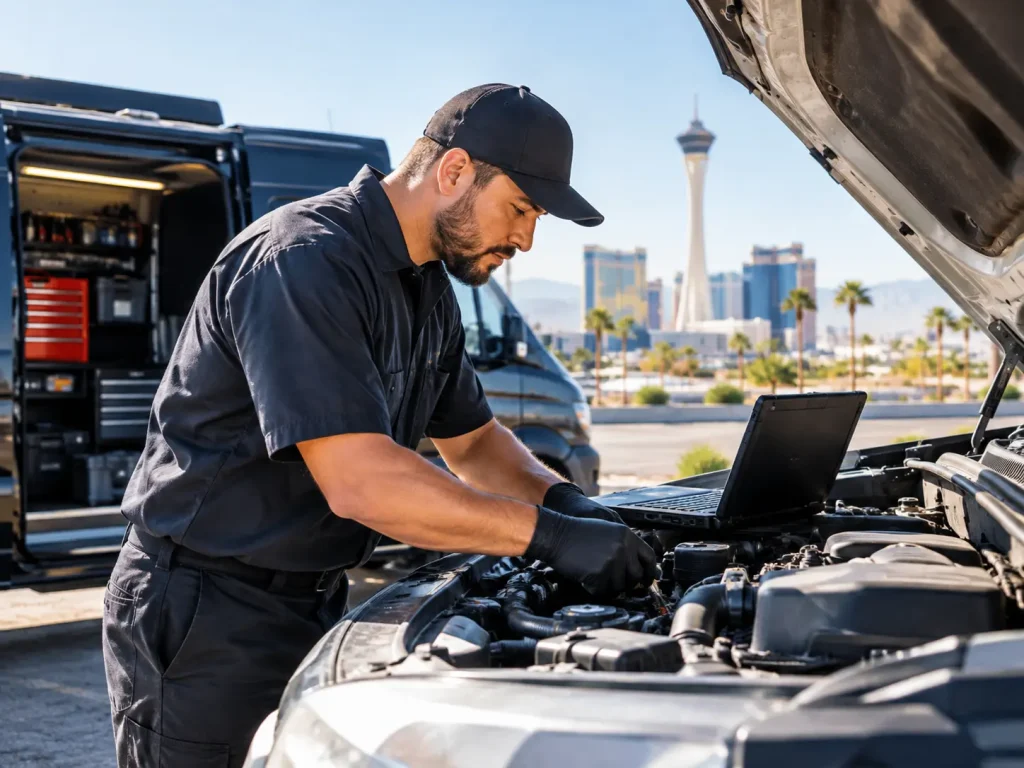
A mobile mechanic can come to your home, workplace, or parking lot, test the battery, and get you running without a tow. If the battery will not hold a charge, a technician can often replace it on the spot. They can also check the terminals and the charging system so you are not left wondering why the car died. Some problems, such as a major electrical fault, may need the equipment of a full shop, and a trustworthy technician will tell you honestly when that is the case. When you call, describe the symptoms, the age of the battery if you know it, and your vehicle’s year, make, and model so the right parts can be ready.
Be Ready Before You Need It
A dead battery rarely picks a convenient moment. Keep a good set of cables or a portable jump starter in the trunk, know where your battery or jump terminals are, and have an older battery tested before winter arrives. A little preparation turns a stressful morning into a quick fix.
To learn more about our services, visit our homepage. If your car will not start or you want your battery tested, reach out through our contact us page and we will come to you anywhere in the Detroit area.